
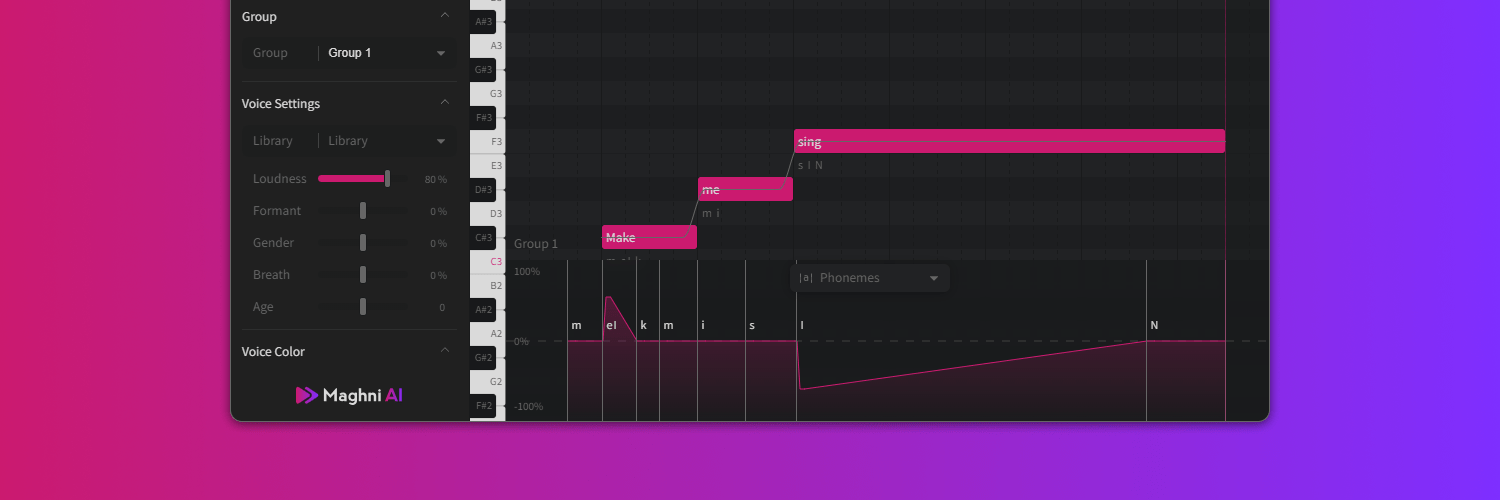
Hello! I'm Miguel Rocha, though many of you may know me as Aku P. For the last year, I've been serving as the GUI Developer and Branding Manager for Maghni AI, an up-and-coming vocal synthesizer planned to release in 2025. In this article, I'll be sharing some of the design philosophy and the development thus far for Maghni AI's in-house editor.
I possess a strong and long-standing passion for UI/UX, and have worked in the industry for various audio and music companies for years. Over these years, having created dozens of tracks with a wide assortment of vocal synthesis software over the last decade, I've developed a lot of solutions, concepts, and fun ideas that, hopefully, fellow synth fans will enjoy, providing users with a seamless and frustration-free workflow; inspiring creativity and allowing more time for creative expression and imagination for both budding musicians and experienced composers.
Why I wanted to develop a voice synthesizer interface
After wrapping up my career as a software engineer, I transitioned into a frontend developer role, where I spent over four years gaining experience and learning the ins and outs of the development process. Along the way, my passion for vocal synthesizers grew, and in 2023, it all clicked. I began working on prototypes and exploring opportunities to pitch my ideas to established products that were missing an interface. By chance, I connected with the Maghni team, and became part of the project in no time.
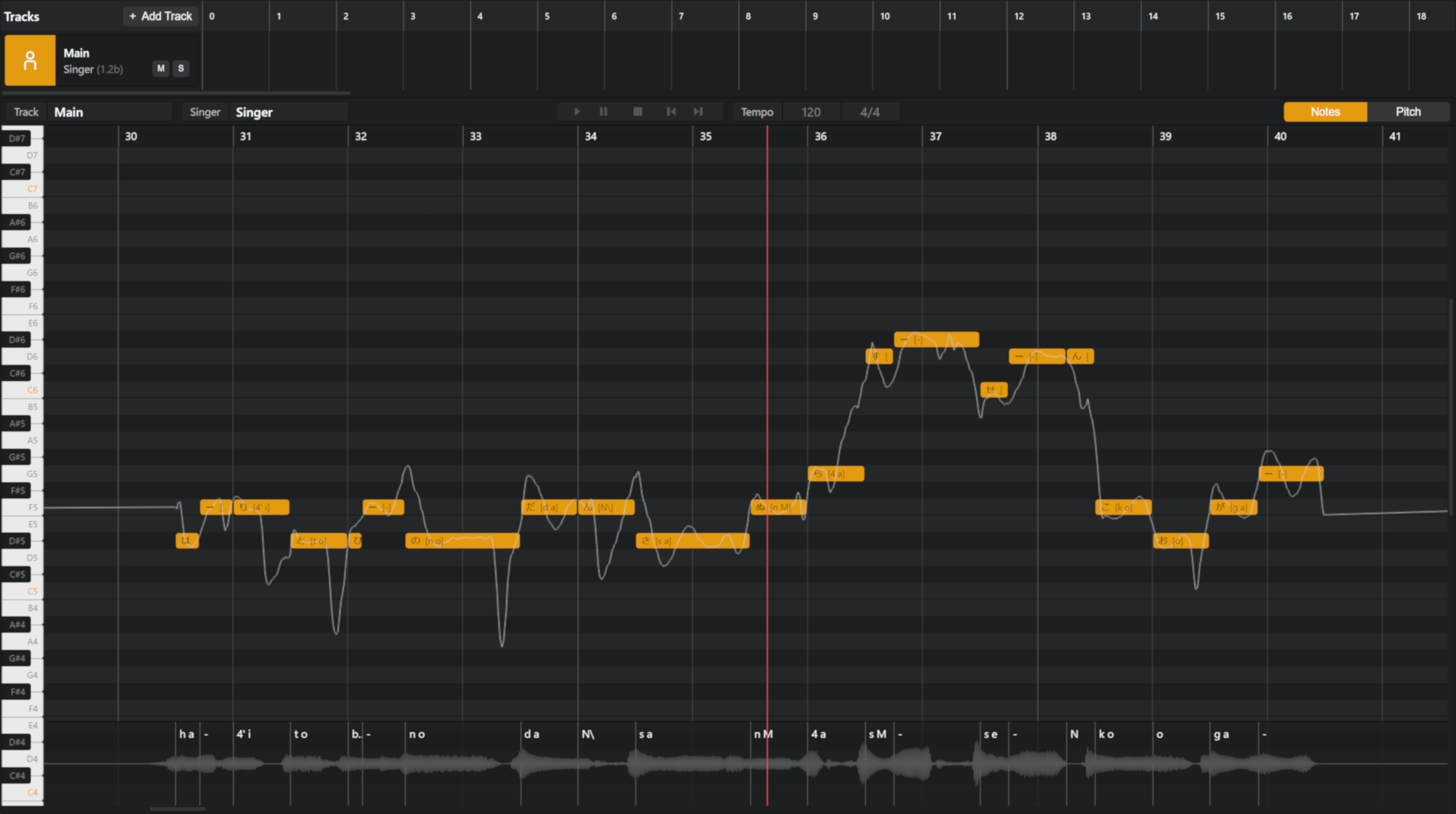
My first prototypes were mostly experiments—testing the technology I needed and getting a feel for how things would work. I knew it would get more complex once real requirements came into play, but these early trials were really valuable. Even in those early stages, the team was pleased with the design, but I had bigger plans: to build a brand-new project from scratch that would be more refined, easier to maintain, and optimized for performance.
The first iterations of the editor varied a bit, but the main goal was to meet a few key requirements, which I'll outline here:
● A minimalistic and compact design.
● An intuitive learning curve, catering to both beginners and experienced users, with just the right amount of tools.
● A fresh, integrated look that emphasized customization and accessibility.
Designing Maghni's layout and color system
The look of a product is crucial—it's my job to ensure that everything the user sees passes through me. I dove deep into research on voice synthesizers, DAWs, and related plugins to understand the landscape. I also drew from my own experiences, conducted internal polls, and explored design websites to gather inspiration. All of this helped me craft an editor that's both simple and powerful, with a design that aligns with the technology it supports.
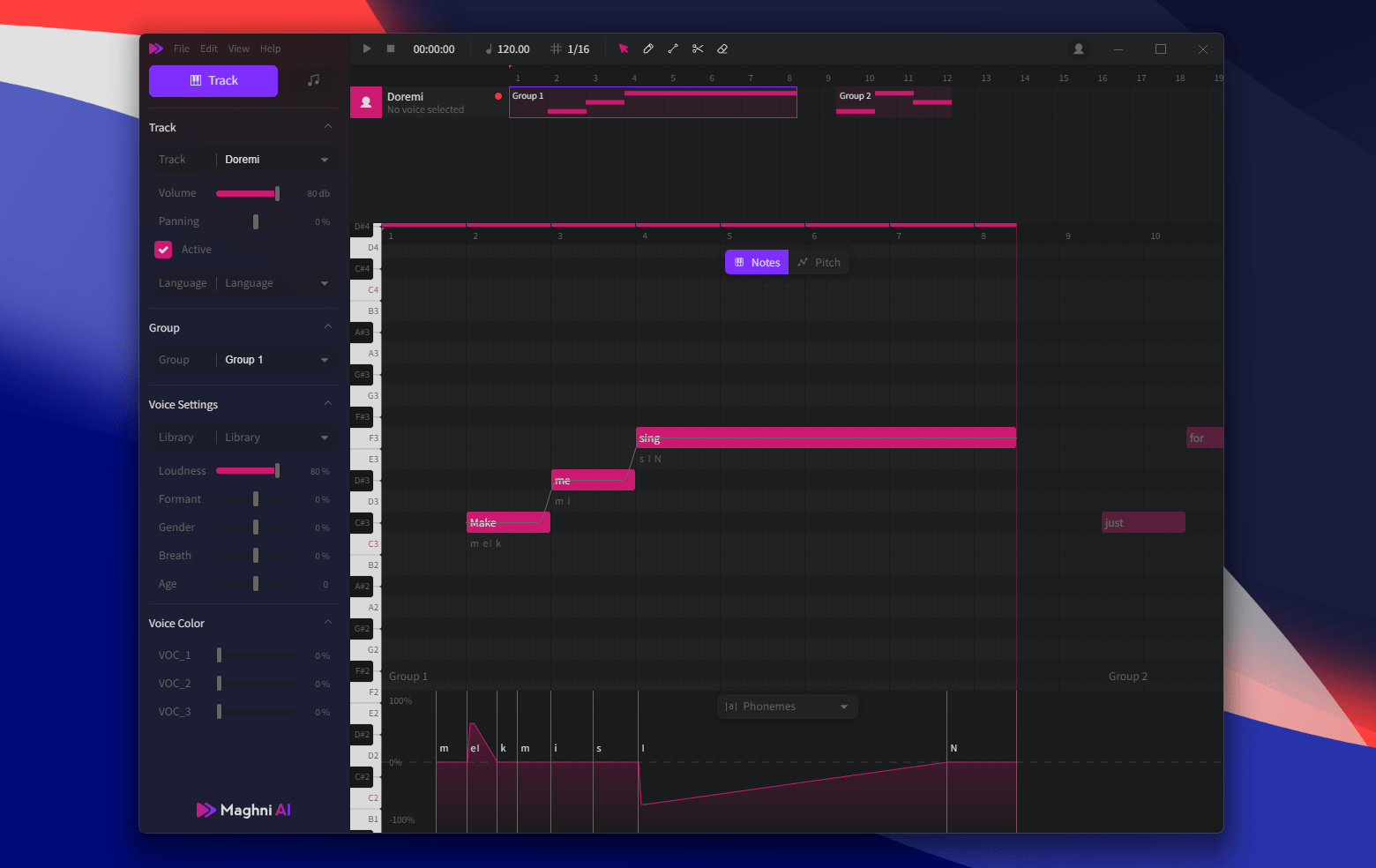
Maghni's editor layout ended up with two main sections: a sidebar where most of the parameters, information, and functions are located, making them easy to find and tweak, and the main workspace, which is designed to be minimal, descriptive, and straightforward. We're also using a two-color system: a primary color for functional elements like notes, buttons, and toggles, and a secondary color for navigation, such as selected views and sections. With just two colors, we were able to create a strong, unified identity (I'll dive deeper into this concept later).
Easy to Learn and Use
The most important requirement was to keep the editor simple and functional, making it easy to learn for both beginners and experienced users. For me, that meant focusing on the minimal number of tools that would be truly useful—at least for the beginning. Over time, we'll see how the software evolves and what new features are needed. We've got plenty of future plans for Maghni, like score reading and text-to-speech, but for now, our focus is on delivering quality over quantity.
Fresh Look
A lot of research went into Maghni's design, and it evolved with each revision. Right now, we've landed on a minimal, native-look design that adapts well to the operating system. Making it feel like a native app (as much as possible) and ensuring it reacts to the OS will help give it longevity in terms of user experience.
Development Progress & Closing Thoughts
As you've probably gathered by now, our development team is small, and we've faced quite a few challenges this past year. With the release of Maghni this year, I'm looking forward to seeing how it performs in the wild, what users think, and continuing to refine the code for a cleaner and more efficient build. Until then, stay tuned!